Tuesday, November 27, 2007

Meiji-Restoration-of-Japon


Explain how Matthew Perry "bullied" the Japanese into signing a trade
treaty. What did he have that impressed the Japanese? Also, explain how
the Japanese economy changed during the Meiji Era. How did they
modernize and industrialize? Finally, Japan is an archipelago - what is
that?

Japan is an archipelago, this means Japan is a large group of islands, which are close to each other, or in near by areas. Like for example another archipelago would be the islands of Hawaii. Like Hawaii, Japan is joined together by various groups of small islands.
Mathew Perry "bullied" the Japanese into singing a treaty by impressing them with the technologies that the Americans enjoyed. The Japanese were very impressed by the technology of the American steam ships. The United States in a way bullied Japan,thats what can be said instead of "negotiating". The United States used their military might to scare the Japanese, or in a scene almost force them. Because Japan had been in isolation for so many years, their army was weak and especially their technology. Perry purposely dropped 26 miles off the coast of Tokyo, to impress the Japanese, which did work. The Japanese were impressed, on how far the ships were able to travel in such a short time. Perry also arrived in Tokyo with the sails of the ship down. He did this purposely, to show the Japanese, that with their steam technology, they no longer needed sails. The Japanese felt intimidated. The advances in technology and the weak navel left Japan hopeless, and in return it was to both United States and Japans best interest that the ports be opened. With this treaty in place, Japan was now able to advance.

Sunday, November 18, 2007

Karl Marx and Communism

explain Karl Marx's idea of Communism. What exactly is Communism? Why did Marx want Communism to take over the world? Who did Marx see as the "good guys" and who did he see as the "bad guys"?

Communism is an economic and political system based on the principle "From each according to their ability, to each according to their need. Marx hated the idea of Capitalism. He hated how the rich became richer and the poor became poorer. He liked the idea of communism because it allowed for equal rights among the people, and the system in place of factory owners getting all the money along with other influential people would finally end. He expressed his points of view and his ideas of communism to the workers, and other poor or middle class people. Many people loved the idea of communism, because this way, they would finally get the rights they longed for. Marx hated the Industrial Revolution, he wanted Communism to be world wide, because this way not only the people of England would have what he thought were equal rights, but everyone else world wide would be able to enjoy what he thought was the best way of life. Marx was truly a man, who was for the people, he always thought in the best interest of the people even though it meant putting in place a system which is so controversial as communism is. Marx saw the low class, working people or the factory workers as the "good guys". This was because they were for his idea of communism and he viewed them as the "victims" of capitalism, always left out, and never being able t advance or better themselves. Karl Marx viewed the factory owners and the people of high power as the "bad guys", because of all the power they had and because they were capitalist. He viewed them as bad guys, because they abused their power over the factory workers, and used Capitalism in their favor to make more money.

Friday, November 16, 2007

Karl Marx and the Industrial Revoltuion


Marx ideas, He was strongly opinionated, and his ideas, impacted the lives of many other people.Marx thought that instead of the the landowners controlling the factories, that the workers should control them instead. He based this, argument, against landowners, and used his similar views and opinions as the workers to unite with them. "WORKERS OF THE WORLD TO UNITE" in a worldwide revolution.
His ideas became known as communism. In a Communist society,workers and people share a common wealth. Marx hated the Revolution because he hated, how it only mad the rich, richer and the poor, poorer. Many people worked long hard hours, only to receive a few quarters in return. Most of the money went to factory owners, and the people doing all the work, received almost nothing. He thought, that wealth should be spread equally, to help others advance. With his idea of communism, people would live fair more equal lives. Although he died in 1883, his ideas were still able to form the basis of the Bolshevik Revolution.

Friday, October 19, 2007

Nationalism and creation of Italy

write a definition of Nationalism and give an example of how you are Nationalistic. What do you do that shows that you are nationalistic?
Then explain how Nationalism was used to create the nation of Italy. What was Italy like before it became Italy? How and why did it become Italy? Explain using your own words.

"Nationalism is a sense of identity with a nation. It is similar to tribalism, and like the family, is held together by a sense of kinship. Liah Greenfeld, Professor of Sociology at Boston University has defined nationalism as "an image of a social order, which involves the people as a sovereign elite and a community of equals". The original use of the term nationalism refers to elite groups, but in modern usage it refers usually to a very large group, sometimes as large as an empire." An example of how I am nationalistic is displaying an American flag in my house or celebrating the fourth of July. Before Italy became nationalistic, it was very separated or divided, each region had its own ruler or king. Italy was united by a man named Giuseppe Garibaldi who was a nationalist. After Italy was united it was able to become more nationalistic. However many wars broke out because of disagreements between Giuseppe Garibaldi and Giuseppe Mazzini (who was an idealist). With all these wars, Italy was spending a lot of money and became a poor country during the 20th century. Above all Italy was able to become an independent nation thanks to Giuseppe Garibaldi. Above all the wars, his nationalistic ideas in some way allowed the country to advance and become better. Because of him Italy was able to become the country that it is today.

Simon Bolivar and the Latin American Revolution.


During the 1800 South and Central America was inspired with what he saw in Europe. People were being governed by their own people. He was very much inspired by the FRENCH AND AMERICAN REVOLUTION. These revolutions were what triggered the Latin American Revolution. After returning to his homeland from Europe he started the Revolution. Simon Bolivar was so important because he was considered responsible for
fighting for the independence of south American countries such as Panama, Ecuador, Peru,Colombia and Bolivia which was named after him ( August 6, 1825), and other countries as well. Thanks to Bolivar, South Americans were able to defeat the Spanish control, through out most of South America. Simon Bolivar was influenced by the French and American Revolution. He saw all these countries ruling themselves, and wondered why they couldn't have or do the same. In time the Latin American Revolution, brought independence to many South American Nations.

Monday, October 1, 2007

The Reign of Terror


The French Revolution promised democracy, but it did not happen immediately. First came "The Reign of Terror". Explain The Reign of Terror and Max Robespierre's involvement in it. Also, why did The Reign of Terror happen? And how were these executions carried out?

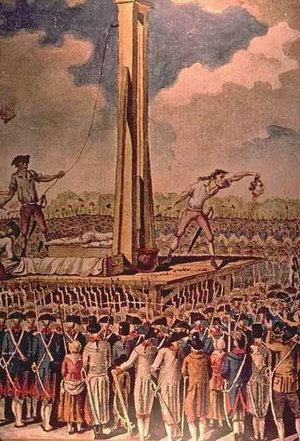
The region of terror was a tall machine, ( as shown is the picture) that was used to cut peoples heads. Of Max Robespierre, was the ruler at the time and used this machine to kill enemies he might have or people who were against him or didn't approve of his rule. This machine was also used to scare its citizens into keeping loyalty. The region of terror represented something horrible in the lives of many people. This ruler killed many people. They were usually tied, the machine had an area were the victim would place their head, and then there head would get sliced off, by a huge machine which carried weight, and came crashing down upon them. Many Innocent people died, because of rumors or speculations, that they might be a trader, or against the ruler. However finally the people got justice. They soon rebelled and took over. Max Robespierre was beheaded in the tower of terror. He finally understood what many people felt moments after death, as he wrote in his diary. So after many deaths, justice was served. After Max's death the tower of terror was still used but in many decreasing amounts. Many more people died, for absolutly no reason under the rule of this ruler.

Thursday, September 27, 2007

The French Revolution


Explain some of the causes of The French Revolution. What were the three estates and why did the third estate feel used? How did the Enlightenment thinkers influence the French Revolution? What really triggered the revolution, what happened on July 14, 1789?

Causes Of the Revolution


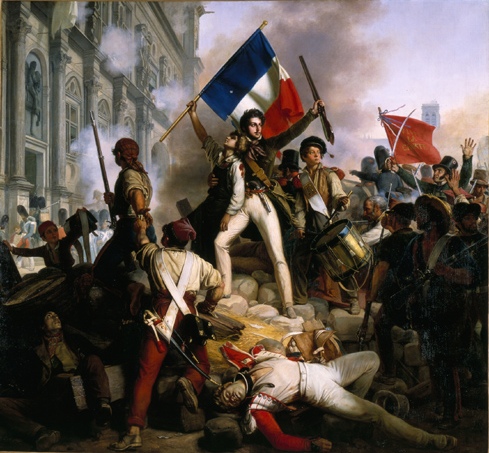
The reasons why the French revolution started was because of the unjust spread of power among the people. There were political and social inequalities. During the 18th century, the French practiced feudalism. The main problem was that nobles and people of the clergy, always had special privileges. They didn't pay taxes, while common people didn't have freedom in politics, and unlike nobles, payed heavy taxes. In the states general, the nobles and clergy made up the fist and second estates, while the rest (common people) made up the third estate.Nobles and people of the clergy could outvote all common people though the Estates General was not always called by the king, who ruled as a monarch. The common people became angry with the privileged class. Which triggered the French Revolution. These people were also inspired by the people of the enlightment,who brought out doubt and question amoung the french. People began to question there ruler, which caused them to rebbel. The storming of the bastille occured on july 14, 1789. The storming of the bastile is seen as a symbol of the upbringing of the new modern france.